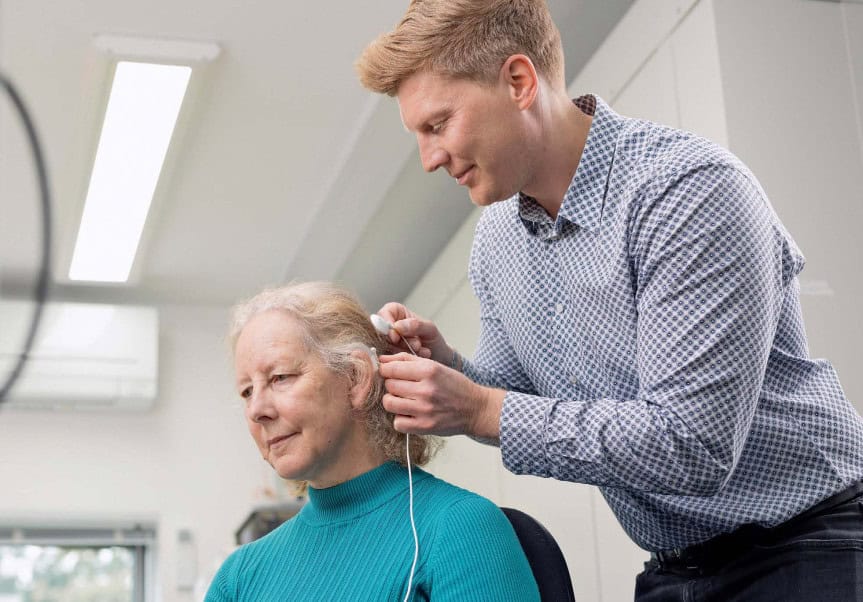
During Deafblind Awareness Week, we’re shining a light on what it means to live with both hearing and sight loss.
Deafblindness creates unique barriers to communication, access to information, mobility and independence. We fund research into conditions that cause deafblindness, with the aim of better understanding how they develop and, ultimately, finding treatments that could protect or restore hearing.
Understanding deafblindness
Deafblindness can be present from birth or develop over time. In many cases, it is caused by inherited genetic conditions that affect both the eyes and the ears, such as:
- Usher syndrome, the most common cause of genetic deafblindness. Children are born deaf or with hearing loss and develop a progressive sight condition called retinitis pigmentosa. Eventually, it leads to combined hearing and vision loss, and sometimes to balance problems.
- Norrie disease, a rare inherited condition that leads to deafblindness. Children are usually born blind, and many begin to lose their hearing from around the age of 12.
There is currently no treatment for either condition.
Cameron and Chapman, two teenagers with deafblindness, share their stories and hopes for the future that this research could bring.
Cameron’s story
Thirteen-year-old Cameron has Norrie disease, which means he was born blind. When he was three, he started losing his hearing.
“I noticed he was becoming more frustrated and scared,” says Cameron’s mum, Carla. “We found out that he’d completely lost his hearing on his right-side. When he was five, his hearing on the left side also began to deteriorate.”
Cameron’s hearing loss has been hard to come to terms with.
“I’ve always said that Cameron’s hearing loss has been the hardest part of our journey. Obviously, I find it sad that he hasn’t got any vision, but because he was born that way, you sort of get to a point where you accept it. But having known him with hearing and getting so much joy from it, and then watching him slowly losing it – that’s been difficult.”
At 12, Cameron had cochlear implant surgery in his right ear. Carla remembers what happened after the implant was switched on:
“After we left the hospital, we went and sat in a park. When a helicopter went past, he went still. Then he opened his eyes, tilted his head towards the sky and really concentrated on the sound. Then he started smiling. He’d heard the helicopter, and it was amazing.”

Carla explains why research into Norrie disease is so important:
“I’m sharing our story because it highlights how important it is for research into Norrie disease to be funded. If there was a cure to stop the hearing loss, that would be life-changing for us. Cameron has got an implant now on the right side, so I think people just assume he can hear again. But he’s never going to be like a hearing person.
His hearing loss still affects him massively. There’s still a high chance that he could lose his hearing in his left ear as well. So it would just be amazing if we could prevent that from happening.”
Chapman’s story
Chapman Shum is a 16‑year‑old pianist who was born blind and later began to lose his hearing. He was given hearing aids and although his condition resembles Norrie disease, it remains undiagnosed.

His dad, Chun, describes the impact:
“Hearing aids amplify all background noises, making it harder to filter out what’s important, and since Chapman experiences the world solely through sound without the aid of vision, he is highly sensitive. However, one unexpected benefit is that Chapman can now hear birds singing again, something he’s always loved but has been missing. Inspired by this, he composed a piece mimicking birdsong.
For someone who is blind and dreams of a career as a professional pianist, losing their hearing is perhaps the most devastating thing that could happen.
Progressive hearing loss is a major concern for people with conditions like Chapman, and having the chance to slow or prevent it could change lives. Knowing that RNID is funding research to reduce hearing loss associated with Norrie disease gives me and Chapman so much hope.”
What research has already achieved
RNID is funding work that not only explains how hearing loss happens in deafblindness, but also moves us closer to treatments that could protect hearing before it is lost.
RNID‑funded research led by Professor Walter Marcotti (University of Sheffield) has helped uncover how changes in a gene called MYO7A, linked to both Usher syndrome and hearing loss, affect the structure and function of sound‑sensing hair cells in the inner ear.
The work showed that the MYO7A protein is essential for maintaining the hair cell ‘stereocilia’, the tiny hair-like structures that allow us to hear. Without it, these structures deteriorate and become more vulnerable.
In a parallel study, Prof Marcotti’s group has shown that gene therapy can restore the structure and function of these cells by replacing the faulty gene with a healthy one. This represents a significant milestone towards future treatments.
The research conducted in my laboratory aims not only to discover the mechanisms underpinning various forms of inherited hearing loss and deafness but also to develop gene therapy interventions for their treatment.
This work is critical to laying the foundation for future clinical trials to address these sensory dysfunctions.”
– Professor Walter Marcotti

Research bringing hope
In partnership with Fondation Pour l’Audition, we are supporting Professor Jane Sowden (University College London) to develop a gene therapy for Norrie disease. Professor Sowden’s earlier work showed how the lack of a protein called Norrin damages the inner ear – and that gene therapy could replace the missing protein and protect hearing.
They are now refining this approach, testing how well it works, and preparing it for potential use in people. If successful, this work will support an application to begin clinical trials, a major step towards a treatment that slows or prevents hearing loss in people with Norrie disease.
My lab’s work in hearing research was motivated by the Norrie Disease Foundation patient group and their need for a treatment to prevent hearing loss for children who are blind. I hope this research will provide the foundation for a first gene therapy clinical trial for deafness in Norrie disease.”
– Professor Jane Sowden

The future of deafblindness research with RNID
Later this year, we’ll be partnering with Fight for Sight to co-fund research into deafblindness through their Small Grants scheme. By working together, we hope to support new ideas and approaches to treating deafblindness, speeding up progress.
With continued research and investment, there is real hope that in the future we will be able to slow, prevent, or even treat hearing loss in deafblindness – transforming lives for people like Cameron, Chapman, and many others.