Caitlin, 28, from Swansea, has experienced healthcare from all angles – as a deaf patient, a nursing student and an intensive care unit (ICU) nurse. Here Caitlin shares her experiences, highlighting why Wales must improve healthcare accessibility and meet deaf people’s communication needs.

Early diagnosis
My parents were so surprised when I was diagnosed as profoundly deaf at 4 years old. I had already learnt to lipread and so the signs weren’t obvious. But I’m so glad that my parents and teachers did notice and had my hearing checked.
I used hearing aids from the age of four but, at 16, my hearing had reached a point where they were no longer giving me access to the full range of sounds.
The journey to cochlear implants
Cochlear implants became the best option for me so, at 17, in the middle of my A-levels, I had eight-hour surgery to have bilateral cochlear implants fitted.
It was a scary time and felt very isolating as I was completely without my hearing for the period after the surgery. I was provided with a notetaker for my A-levels, but I had to work very hard as I missed out on a lot of information.
Starting my nursing journey
In spite of the surgery disrupting my A-levels, I was successful in getting a place to study nursing at university, later starting work as a nurse in the intensive care unit.
I had only been qualified as a nurse for six months when the COVID-19 pandemic happened. We were thrust into protective equipment, wearing ventilated hoods and everyone was wearing masks which made it impossible to lipread. This was a terrifying time for me because I had no idea how I would cope.
I think there’s a misconception that if you have cochlear implants or hearing aids, you can hear everything. I can’t hear if someone’s not looking at me; I need that face-to-face interaction so I can lipread constantly.
Working in ICU during COVID-19
This time starting my career in ICU was a huge challenge. Patients were wearing masks, so I would have to rely on medical notes to know what the doctors wanted the nurses to do.
When patients are in ICU and coming out from sedation, we may ask a patient to squeeze our hand to let us know that they understand us. This is how we assess their neurological status and ensure they’re awake enough to extubate.
It is vital to know if patients are deaf, so we can determine why they may be unresponsive. Is it because of a deterioration in their condition, or does it indicate that they need additional support and understanding, like making sure hearing aids are in place and that they can lipread the medical professional?
A knowledge gap in healthcare training
There’s a huge knowledge gap for healthcare services in terms of how to support deaf patients. In nursing school, there were no classes about hearing aid care and how to communicate with deaf patients, even though the majority of the elderly population has hearing loss. By contrast, we did get classes on eyesight, denture care, and helping patients eat.
The need for training is not just about direct communication; it’s also how to care for hearing technology – basic things like how to change hearing aid batteries or how to clean the tubes. These things will help support communication between staff and patient.
The need for deaf awareness training
I’ve been asked by colleagues to support patients who are hearing aid users. I could see that the tubes were completely blocked with wax, which is very common. I managed to clean out the tubes, and the patient was delighted that she could hear so much better and communicate about her treatment and care. If I hadn’t been there, how would they have communicated with her?
Deaf patients may often have to advocate for themselves and for their own needs because of a lack of awareness. When I started in nursing, it was very hard to find information about how to book an interpreter via the health board, which is essential for patients who are BSL users.
Inaccessible appointments
Whenever I go to the GP, I tell them that I’m deaf and that I can’t hear them when they call my name. But I was once left waiting for an hour because they thought I wasn’t there – even though I had asked them when I arrived to notify me otherwise. I think a vibrating pager system would make a difference.
I often have to remind the doctor to face me when talking multiple times within the same appointment. I do understand that services are overwhelmed – I see that first-hand as a nurse. But communicating effectively with patients should be a standard of care no matter what, and it can be critical.
We have to find ways to improve services so that they cater for deaf people’s communication needs.
Improving communication saves lives
We know from literature that deaf patients may delay or avoid seeking treatment, affecting not only their physical but their mental health.
Seeing patients potentially struggle made me think about myself as a cochlear implant user. If I was unconscious as a patient, healthcare professionals may have no knowledge of how cochlear implants work or how to put them on for me to communicate. This would have a major effect on my own mental health and care.
This motivates me to continue rolling the guidance out, so everyone is increasingly aware.
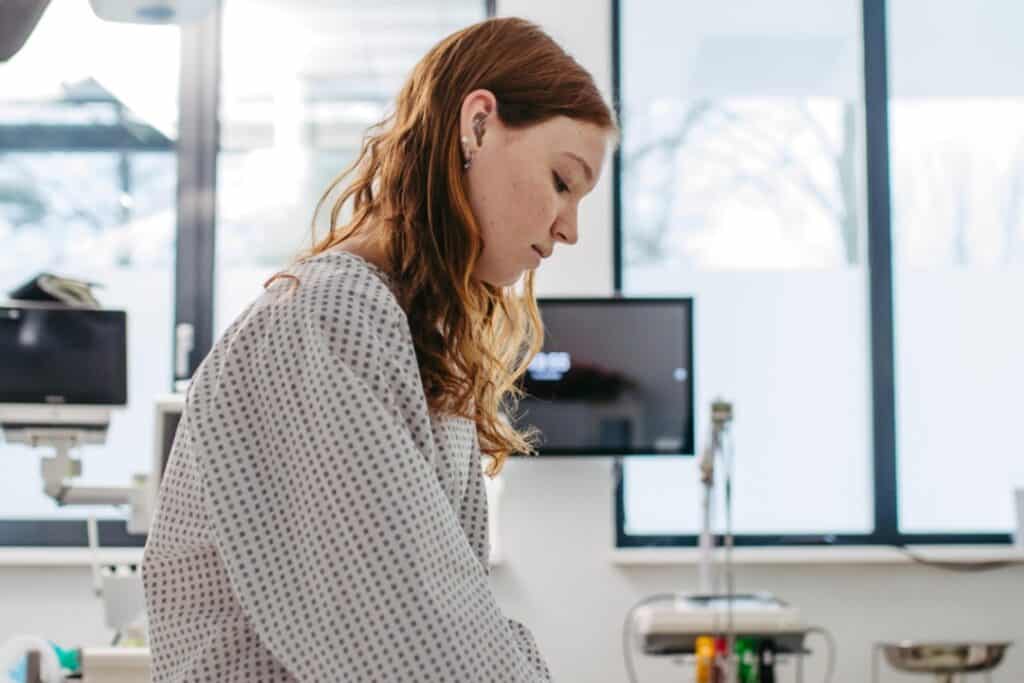
Fight for accessible healthcare
We need UK governments to enforce the legal right to accessible healthcare for those who are deaf or have hearing loss. Please add your voice and write to your elected representative today.